



















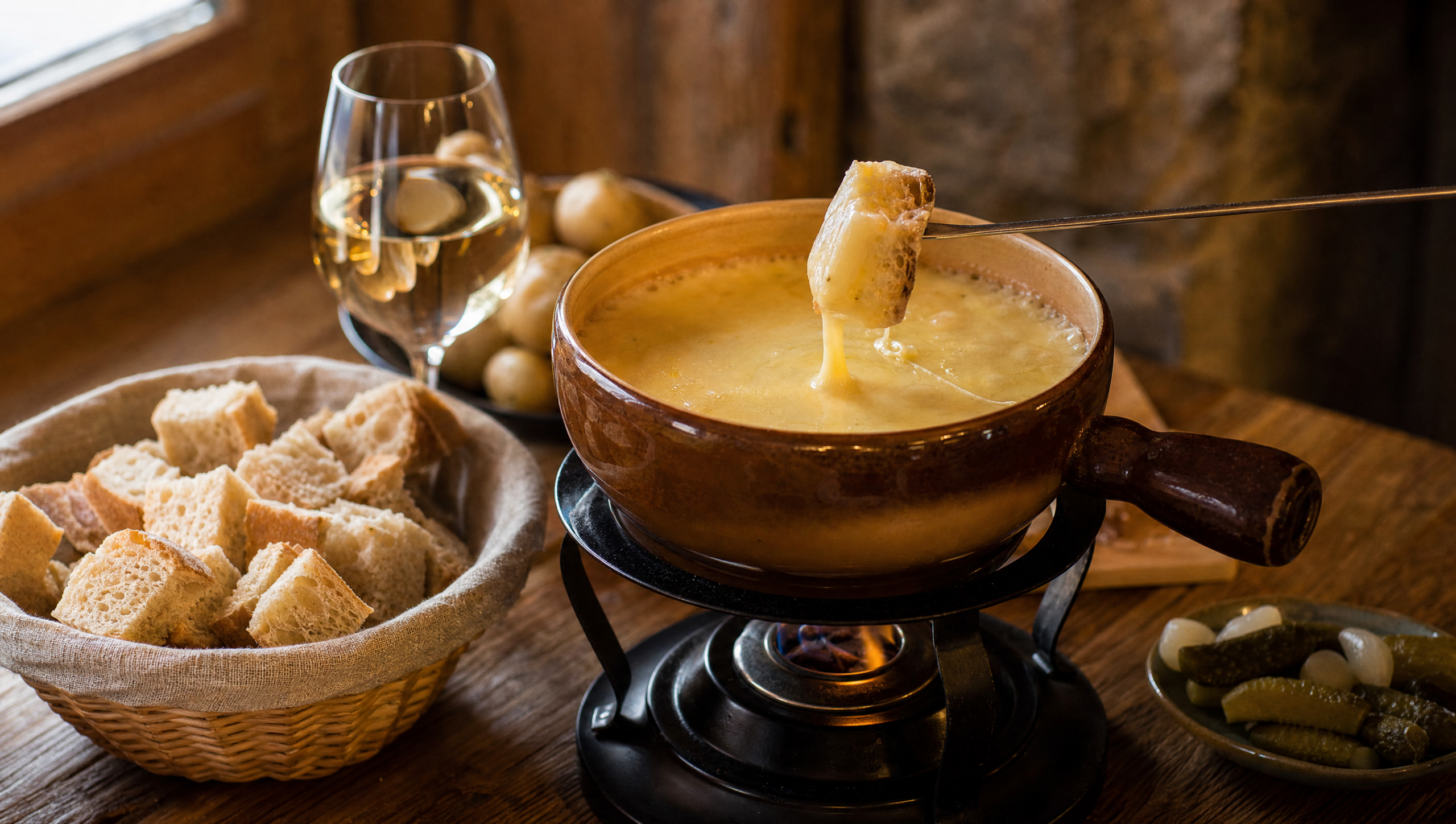
Swiss cheese fondue is a warm dish of melted cheese, usually blended with white wine and a touch of garlic, eaten by dipping cubes of crusty bread on long forks. The most traditional versions rely on firm Swiss mountain cheeses such as Gruyère and Vacherin Fribourgeois, often combined in the classic moitié-moitié (“half-and-half”) style. If you want an authentic result without sourcing and grating cheese yourself, ready-made Swiss fondue blends are a practical shortcut.
This guide explains what defines an authentic Swiss cheese fondue, which cheeses are typically used, how to choose between making it from scratch or buying a ready-made blend, and how to melt and serve it well. Where exact details depend on the product, the product page should confirm the specifics.
What is Swiss cheese fondue?
Fondue comes from the French fondre, meaning “to melt.” In its Swiss form, the dish is built around cheese melted gently with white wine and a little acidity, then kept warm over a small burner in a wide, shallow pot called a caquelon. Diners spear bread cubes and swirl them through the cheese, which keeps it smooth and prevents it from setting.
Swiss cheese fondue is defined less by a single recipe than by a method: firm alpine cheeses melted slowly with white wine and acidity until smooth, then kept warm and stirred continuously as it is shared from one pot.
Fondue is closely tied to Swiss winter and social dining, and it sits alongside raclette as one of the country’s best-known cheese dishes, a tradition promoted by Switzerland Tourism. For more on how these traditions compare, see our overview of iconic Swiss cheese dishes.
Which cheeses are used in authentic Swiss fondue?
Authentic Swiss fondue typically uses firm, well-aged mountain cheeses that melt smoothly and carry flavour. The exact blend varies by region and household, but a few cheeses appear again and again.
The most traditional Swiss fondue blend is moitié-moitié — roughly half Gruyère and half Vacherin Fribourgeois — which balances Gruyère’s structure and nutty depth with the softer, creamier melt of Vacherin.
Gruyère
Gruyère is a firm cow’s-milk cheese from the Fribourg region and one of the cornerstones of Swiss fondue. Aged Gruyère brings a nutty, slightly savoury depth and melts into a stable, cohesive base. Many recipes use it as the dominant or sole cheese, as in the ready-made Gerber Fondue Le Gruyère AOP (800g), a single-cheese Swiss cheese fondue based entirely on Gruyère.

Vacherin Fribourgeois and the moitié-moitié blend
Vacherin Fribourgeois is softer and creamier than Gruyère and melts at a lower temperature, which gives fondue a smoother, more elastic texture. Combining the two in equal parts produces the famous moitié-moitié style. Ready-made examples of this pairing include the Swiss Fondue Moitié-Moitié family pack (2x400g) and the smaller 200g Moitié-Moitié pack for one or two people.

Emmental and regional variations
Emmental, with its mild flavour and familiar holes, is sometimes added to lighten the blend, though purists often prefer Gruyère-led mixes. Other regional cheeses such as Appenzeller may appear in local variations, for example the Authentic Appenzeller Fondue (2x400g). There is no single “correct” recipe — blends reflect regional taste and tradition.
| Syr | Texture and flavour | Role in fondue |
|---|---|---|
| Gruyère | Firm, nutty, savoury when aged | Structural base; flavour backbone |
| Vacherin Fribourgeois | Soft, creamy, lower melting point | Adds smoothness and elasticity |
| Emmental | Mild, slightly sweet | Optional; lightens the blend |
| Appenzeller | Aromatic, tangy | Regional accent in some blends |
Should you make fondue from scratch or buy a ready-made blend?
Both approaches can deliver an authentic Swiss cheese fondue. Making fondue from scratch gives you full control over the cheese ratio, the wine, and the seasoning, but it requires sourcing the right cheeses, grating them, and managing the melt carefully. Ready-made Swiss fondue blends are pre-portioned and formulated to melt smoothly, which makes them convenient for first-timers or for buyers outside Switzerland who cannot easily find Gruyère and Vacherin. A ready-to-heat option such as the Gerber L’Original Ready-to-Eat Fondue Mix only needs warming through.
For buyers outside Switzerland, a ready-made moitié-moitié blend is often the most reliable way to recreate an authentic fondue, because the cheese ratio and melt have already been balanced for you.
If you prefer convenience, browse the range of authentic options in the Swiss fondue collection, which includes traditional cheese blends and ready-to-heat mixes. When comparing products, check the listed cheeses, weight, and serving size on each product page, since these vary between options.
How to prepare Swiss cheese fondue at home
The method matters as much as the cheese. The goal is a smooth, glossy pot that stays liquid throughout the meal rather than separating or turning stringy. A dedicated set such as the KUHN RIKON Súprava na syrové fondue Suisse includes a caquelon and burner sized for sharing.
A smooth fondue depends on gentle, steady heat and acidity: melting the cheese slowly with white wine, and stirring in a figure-eight motion, helps the fat and proteins stay emulsified instead of splitting.
A typical approach, which you should adapt to the specific product or recipe you are using:
- Rub the inside of the caquelon with a cut clove of garlic.
- Warm dry white wine gently; a small amount of lemon juice or a splash of kirsch is often added.
- Add grated cheese gradually over low heat, stirring continuously until melted and smooth.
- Many recipes use a little cornstarch to help stabilise the mixture.
- Move the pot to a table burner and keep it warm, stirring as you dip.
If you are using a ready-made fondue, follow the heating instructions on the packaging, as preparation times and added ingredients differ between products.
Storage, serving, and what to dip
Cheese is sensitive to temperature, so storage and serving conditions affect the result of any Swiss cheese fondue. Keep cheese or sealed fondue blends refrigerated until use, and check the best-before i