
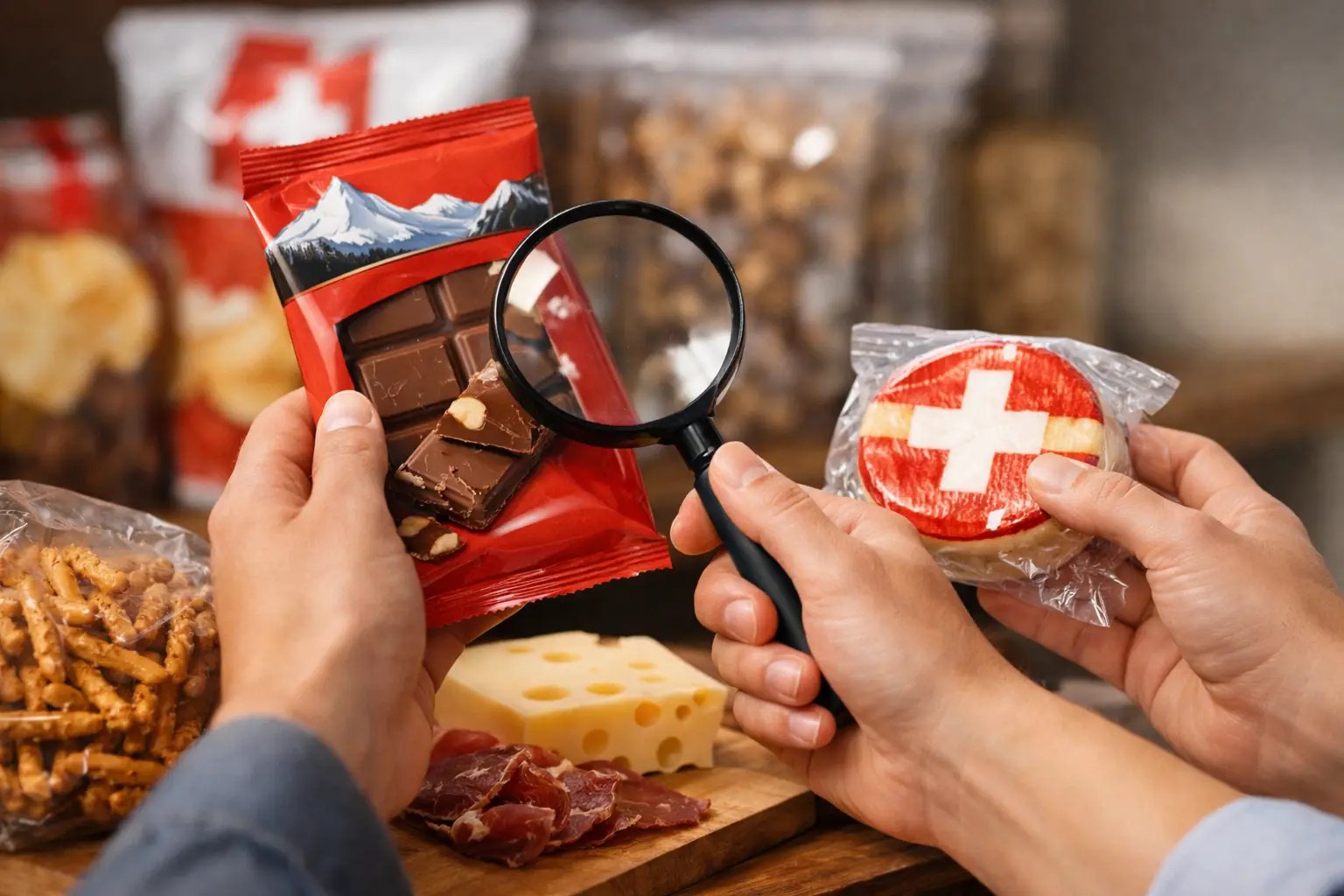
A package covered in red and white can look convincingly Swiss from a supermarket shelf thousands of miles away. But a Swiss flag, an Alpine illustration, or the word “Swiss” in a product name does not always tell you where the snack was actually made. Knowing how to identify Swiss made snacks helps you spend confidently when you are buying familiar favorites, choosing a gift, or trying something new from Switzerland.
For packaged snacks, the best evidence is usually on the back or side of the pack: the origin statement, the producer’s address, and the precise wording around where the product was made. A few minutes of label reading can separate genuinely Swiss-made biscuits, chocolate, candy, and savory snacks from products that simply borrow Swiss imagery.
Start with a clear country-of-manufacture statement
The most useful wording is direct. Look for phrases such as “Made in Switzerland,” “Produced in Switzerland,” or an equivalent statement in the language used on the package. Swiss products are often labeled in German, French, Italian, and sometimes English, so the wording may vary.
Common phrases include “Hergestellt in der Schweiz” in German, “Fabriqué en Suisse” in French, and “Prodotto in Svizzera” in Italian. You do not need to speak all of these languages fluently. What matters is recognizing the country reference and whether it is connected to production, rather than merely to a brand story or distributor.
A statement such as “Swiss recipe,” “Swiss quality,” or “Swiss-style” is different. It may describe flavor, inspiration, or marketing positioning, but it does not confirm the snack was made in Switzerland. The same applies to a Swiss company name when the package states a different country of production.
Check the producer, not only the brand
A recognizable Swiss brand is often a positive sign, especially when its packaged products are produced in Switzerland. Still, brands can operate across multiple markets, and manufacturing locations may vary by product. Check the specific package in front of you rather than relying only on the name on the front.
Look for the manufacturer or producer details on the back panel. A Swiss town or Swiss postal address is helpful context, particularly when it appears alongside a clear Swiss manufacturing statement. However, an address alone is not final proof. A company can have a Swiss office, importer, or brand owner while production takes place elsewhere.
The strongest combination is simple: a named producer in Switzerland and a clear indication that the product was made there. This is especially useful when choosing classic packaged specialties such as chocolate bars, biscuit assortments, candy, seasoning blends, shelf-stable rösti, fondue mixes, or spreads.
Understand the difference between producer and importer
International retail packages may also list a local importer, distributor, or responsible business in the United States, the UK, or another destination market. That information is normal and can be useful for local labeling requirements. It does not replace the original manufacturer details.
When reading the package, distinguish between “manufactured by” and “imported by” or “distributed by.” The producer tells you who made the snack. The importer tells you who brought it into a market. Both can appear on the same package, but they answer different questions.
Treat Swiss symbols as supporting clues
The Swiss cross, mountain scenes, chalet graphics, and references to Swiss tradition can be meaningful branding elements. They can also make a product feel more Swiss than it is. Use them as supporting clues, never as your only test.
Authentic Swiss packaging often reflects the country’s multilingual market. It may feature German, French, Italian, or Romansh alongside English. A package with several Swiss national languages can be a useful indication that it was designed for the Swiss market, though it is not a guarantee by itself.
The same principle applies to a Swiss flag. Switzerland has rules around the use of Swiss indications of source, but shoppers should still read the full label. A symbol may communicate a brand’s Swiss identity, while the country-of-manufacture statement provides the practical confirmation you need.
Do not rely on the barcode alone
One of the most common shortcuts is checking whether a barcode begins with a number commonly associated with Switzerland. This can be a clue about the organization that issued the barcode number, but it is not reliable proof of where a snack was made.
Barcodes are tied to company registrations and supply-chain systems, not a simple country-of-production certificate. A Swiss-registered company may sell products made elsewhere, while a product made in Switzerland may be labeled for international distribution in a different way. Use the barcode only as a minor detail after you have checked the origin statement and producer information.
Read ingredient claims carefully
A snack can contain a Swiss ingredient without being Swiss-made. For example, chocolate may mention Swiss milk, Swiss cocoa processing expertise, or a Swiss-developed recipe. Those claims may be relevant to taste and product identity, but they are not the same as manufacturing origin.
Likewise, a snack made in Switzerland may use ingredients sourced from more than one country. That is common in packaged food production and does not make the product less authentically Swiss-made. The key question is where the finished consumer product was produced and packed, not whether every ingredient originated within Switzerland.
This distinction matters most with chocolate and confectionery, where language about cocoa, milk, recipes, and craftsmanship can be detailed. If your priority is a snack made in Switzerland, look for that production claim first. Then explore the ingredient list and product description for the flavor, texture, and dietary details that matter to you.
Use the packaging style to spot market-specific products
Products intended for the Swiss domestic market often carry familiar regional features: several official languages, Swiss recycling information, local nutrition formats, and manufacturer details from a Swiss canton or municipality. These details can make a package feel immediately recognizable to Swiss expats and travelers who remember seeing it in Swiss shops.
Still, export packaging can look different. A genuine Swiss-made snack prepared for customers abroad may have English labeling, added importer information, or market-specific nutrition panels. That does not reduce its authenticity. The question remains whether the original product was made in Switzerland.
For online shopping, clear product photographs are particularly valuable. Before adding an item to your cart, look for images of the front and back of the package, as well as an accurate product description that identifies the brand, format, and country of origin where available. If those details are vague, it is reasonable to ask the retailer before ordering.
Choose retailers that make provenance easy to verify
A specialist retailer should make it easier to buy Swiss products without decoding misleading marketing. Look for a focused selection of consumer-ready, shelf-stable Swiss foods, recognizable product names, and descriptions that match the packaging. A curated assortment is often more useful than a broad marketplace where “Swiss” can be used loosely across thousands of listings.
It also helps when the store ships from Switzerland and centers its selection on authentic Swiss-origin products. At Swissfood.store, the emphasis is on packaged Swiss favorites selected for international private customers, from nostalgic treats to gift-worthy specialties. Even so, product labels remain your best source for verifying the individual item you choose.
A quick label-check routine
Before you buy, take a moment to confirm four details:
- A direct “Made in Switzerland” or equivalent production statement
- A manufacturer or producer address in Switzerland
- Packaging details that align with the product’s stated Swiss origin
- A retailer description that is specific about the actual product, not just Swiss-themed marketing
If one detail is missing, that does not automatically mean the snack is not Swiss-made. Packaging varies by brand and export market. But when several details line up, you have a far stronger basis for choosing with confidence.
The best Swiss snack is often the one that brings back a train-station chocolate stop, a family holiday, or a favorite flavor you cannot find locally. Let the label do the confirming, then choose the biscuit, candy, chocolate, or savory specialty you will be genuinely happy to open or share.